
The Hidden Cost of Wearing the Wrong Bra: Are Cheap Bras Actually Saving You Money?
You found a bra for R600. It looks like a bargain.
You buy six of them because they are affordable, easy to find and you think you are getting your money’s worth.
But six months later, the band isn’t as firm. The cups don’t sit quite the way they did when the bras were new. The straps seem to need constant adjustment. Perhaps the underwire starts digging in, or the bra simply doesn’t feel as supportive anymore.
So you buy another few.
And then another few.
Suddenly, that “cheap” bra isn’t looking quite so cheap.
At Lady Things Bra Boutique, we believe that buying a bra should be about value, fit, support and longevity – not simply the price on the label.
And when you look at what you could spend on bras over two years, the difference can be surprisingly large.
The real cost of a cheap bra
Let’s look at a realistic example.
Imagine Woman A buys six bras from a mainstream retail store at approximately R600 each.
Her initial investment is:
6 × R600 = R3,600
If those bras maintain their shape and support for approximately 6 to 8 months, she may need to replace her collection three to four times over a two-year period.
Over two years:
6-month lifespan | 8-month lifespan | |
Initial 6 bras | R3,600 | R3,600 |
Replacement cycles needed | 4 | 3 |
Approximate 2-year spend | R14,400 | R10,800 |
So Woman A could spend approximately R10,800 to R14,400 over two years simply maintaining a collection of six bras.
And that doesn’t include the frustration of buying bras that don’t fit properly, the time spent shopping for replacements, or the bras sitting unworn at the back of the cupboard because they never felt quite right.
Now meet Woman B.
Woman B decides to invest in three quality bras selected specifically for her body, breast shape, lifestyle and support requirements.
Her three bras cost approximately R3,300 in total.
With proper care and rotation, she can reasonably expect her bras to maintain their shape and support for approximately two years.
Her two-year cost:
3 bras = R3,300
That’s it.
The difference is substantial.
Depending on how quickly Woman A needs to replace her bras, Woman B could spend approximately:
R7,500 to R11,100 LESS over two years.
That’s a potential saving of up to R11,100 – despite paying more per bra at the beginning.
But isn’t R1,100 for a bra expensive?
It can certainly feel that way when you’re standing in a shop looking at the price tag.
But price and value are not the same thing.
A R600 bra that needs replacing every six months costs approximately:
R100 per month
A R1,100 bra that lasts two years costs approximately:
R46 per month
And that’s before considering the difference in support, comfort, fit and how often you actually reach for the bra in your drawer.
The question shouldn’t always be:
“How much does this bra cost?”
A better question is:
“How much does this bra cost me per month of proper support?”
The problem isn’t necessarily that cheap bras are “bad”
Let’s be fair.
A less expensive bra isn’t automatically a bad bra.
There are perfectly good affordable bras, and some bras can last considerably longer than others depending on their construction, how often they are worn and how they are washed and dried.
The bigger problem is often buying a bra based primarily on price rather than fit and purpose.
A bra that doesn’t fit correctly can be under unnecessary strain from the moment you put it on.
If the band is too loose, it may ride up and fail to provide the support it should.
If the cups are too small, breast tissue can be pushed where it shouldn’t be.
If the straps are doing all the lifting, they can dig into your shoulders.
If the wires are sitting on breast tissue rather than surrounding it, the bra can become uncomfortable very quickly.
A properly fitting bra distributes support much more effectively. Research into breast-support garments has also found that improving bra fit can change breast support and aspects of spinal posture, particularly in women with larger breasts.
The hidden cost isn’t only financial
There is another cost that is much harder to calculate:
frustration.
How many times have you:
- bought a bra and then hardly worn it?
- taken it off because it became uncomfortable?
- constantly pulled your straps back onto your shoulders?
- adjusted your band throughout the day?
- avoided certain tops because your bra didn’t look right underneath?
- bought another bra because the first one “just wasn’t quite right”?
- kept a drawer full of bras but only had two or three favourites?
Those unworn bras aren’t bargains.
They are money sitting in your cupboard.
And if you’re struggling to find bras in your size, the problem becomes even more expensive because you may repeatedly buy something that is available, rather than something that is actually right for you.
A professional bra fitting can change how you shop
One of the biggest advantages of a professional bra fitting is that you stop starting your shopping journey with:
“What size am I?”
Instead, you start with:
“What actually fits me?”
Bra sizing isn’t completely universal. Different brands, styles and constructions can fit differently, which is why a professional fitting should involve more than simply measuring around your body and handing you a number.
At Lady Things Bra Boutique, your fitting is personal and one-on-one.
We look at how the bra sits on your body.
We consider:
- your underbust and bust measurements
- your breast shape
- your proportions
- the amount of support you need
- the style you want
- what you will be wearing the bra with
- your comfort
- and, importantly, how the bra actually behaves when you move.
Because the “right size” on a label isn’t necessarily the right bra for you.
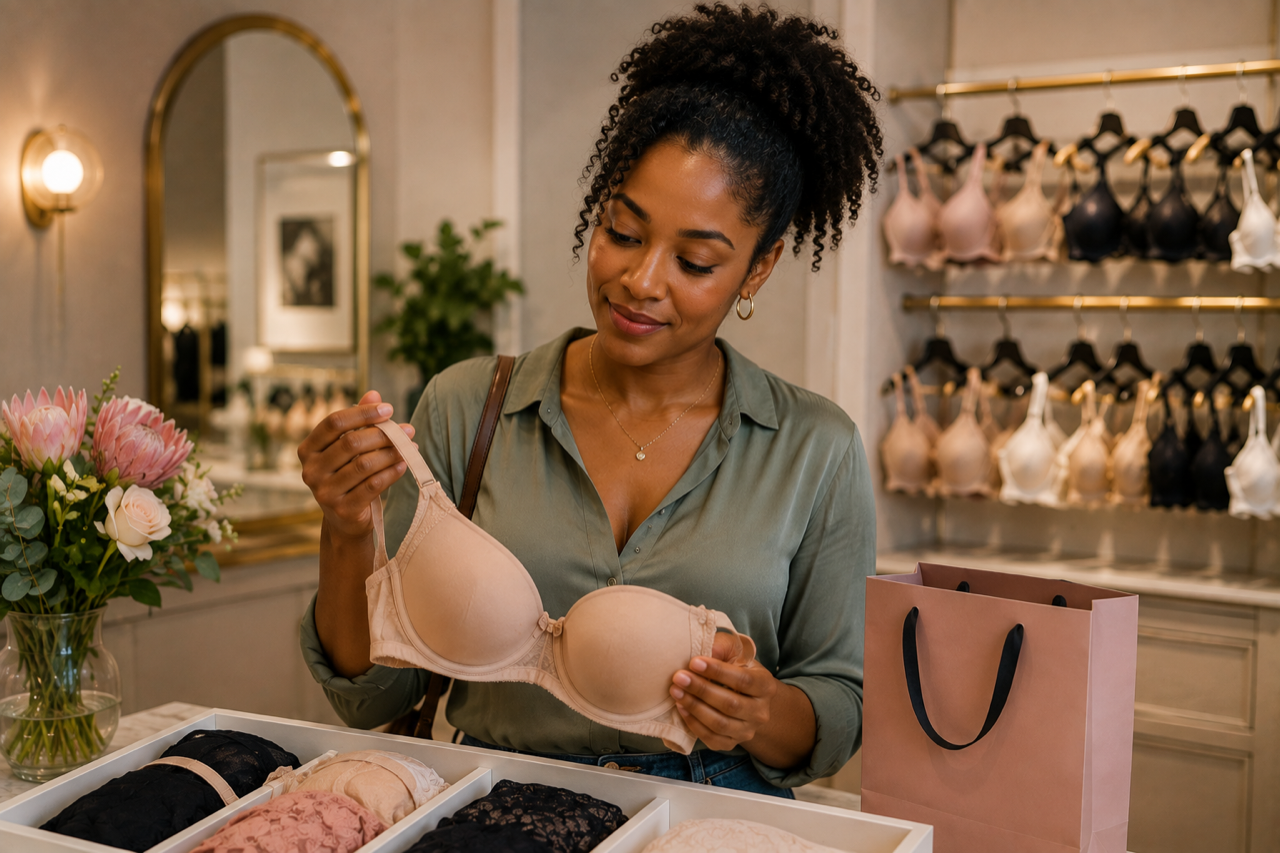
Three bras can be better than six
This is something many women find difficult to believe at first.
“Only three bras?”
Yes – if they are the right three.
You don’t necessarily need a drawer overflowing with bras.
You need a collection that works for your lifestyle.
For example, your wardrobe might need:
Three Everyday Bras: One to Wear, One to Wash, One in the Drawer
When it comes to your everyday bras, we recommend keeping things simple:
One on you.
One in the wash.
One in the drawer.
That’s your basic rotation.
Having three good-quality everyday bras means you can rotate them rather than wearing the same bra day after day. This gives the elastic and fabric time to recover between wears and helps extend the life of your bras.
And importantly, these three don’t have to be boring!
Your everyday bra should be comfortable, supportive and versatile enough to wear regularly. You may have different colours or styles depending on your wardrobe, but the principle remains the same: three reliable everyday bras that you rotate.
But what about strapless, sports and beautiful bras?
Those are in addition to your basic three.
Your wardrobe may also need specialist bras for particular situations, such as:
- Sports bras for exercise and active days
- Strapless bras for outfits where you don’t want visible straps
- Plunge or low-cut bras for particular necklines
- Special occasion bras for when you want something extra beautiful, feminine or sexy
There is one important exception worth mentioning: our strapless bras are not limited to being worn strapless.
At Lady Things, our strapless bras have excellent detachable straps, which means they can easily become an everyday bra when the straps are attached. You essentially get the versatility of a strapless bra and a perfectly wearable everyday bra in one.
So, your wardrobe doesn’t need dozens of everyday bras.
Think of it as:
3 everyday bras + the specialist and special-occasion bras your lifestyle actually requires.
The goal isn’t to own fewer bras simply for the sake of owning fewer.
The goal is to have the right bras for the right occasions – and to actually wear and enjoy every one of them.
And here’s the secret: look after them
Even the best bra won’t last forever.
Elastic is designed to stretch, and repeated wear, washing, heat and incorrect care can accelerate deterioration.
Rotating your bras rather than wearing the same one every day gives the elastic time to recover. Gentle washing and avoiding tumble-dryer heat can also help preserve elastic and shape.
At Lady Things, we recommend treating your bras as the investment they are.
A little care can make a significant difference to how long they remain supportive and beautiful.
So, is the cheapest bra really the cheapest?
Let’s go back to our two women.
Woman A
6 bras × R600 = R3,600
If they need replacing every 6–8 months:
Approximately R10,800–R14,400 over two years
Woman B
3 quality bras = approximately R3,300
With proper rotation and care:
Approximately R3,300 over two years
Two-year difference:
Woman B could save approximately R7,500–R11,100.
And she gets to spend those two years wearing bras that fit properly, provide the support she needs and make her feel comfortable.
That’s the difference between buying a bra and investing in the right bra.
Stop buying bras for the price tag
The next time you see a R500 or R600 bra and think:
“What a bargain!”
Ask yourself a few more questions.
Does it fit me properly?
Will it provide the support I need?
How long is it likely to maintain its shape?
Will I actually wear it?
Am I buying it because it’s right for me – or simply because it’s available in my size?
Because a cheap bra you don’t wear isn’t a bargain.
And a quality bra that you wear constantly, care for properly and rely on for years may be one of the better investments in your wardrobe.
Your bra should work for you – not against you.
At Lady Things Bra Boutique in Pretoria, every fitting is private, personal and one-on-one.
We specialise in helping women who struggle to find bras that genuinely fit – including fuller busts, larger cup sizes, petite frames with fuller busts and women who simply haven’t found the right fit in mainstream stores.
The fitting is free. Your time is valuable. And the aim is simple: to help you find bras you actually love wearing.
FAQs
Yes. Your bra size can change because of weight fluctuations, pregnancy, breastfeeding, hormonal changes, menopause, ageing, and even changes in muscle tone. It’s normal for your size to change over time.
Home measurements can provide a useful starting point, but they cannot account for breast shape, tissue distribution, or differences between bra styles. A professional bra fitting offers a far more accurate assessment.
We recommend having a professional bra fitting approximately every 12 – 24 months, or sooner if you’ve experienced significant body changes such as weight loss, pregnancy, or hormonal changes.
Many retailers only stock a limited range of sizes, particularly for fuller bust women. Specialist bra boutiques like Lady Things offer a much wider selection of band and cup combinations designed to provide proper support and comfort.

